

The Ripple Effect: Quantifying the Impact of Curry’s Absence
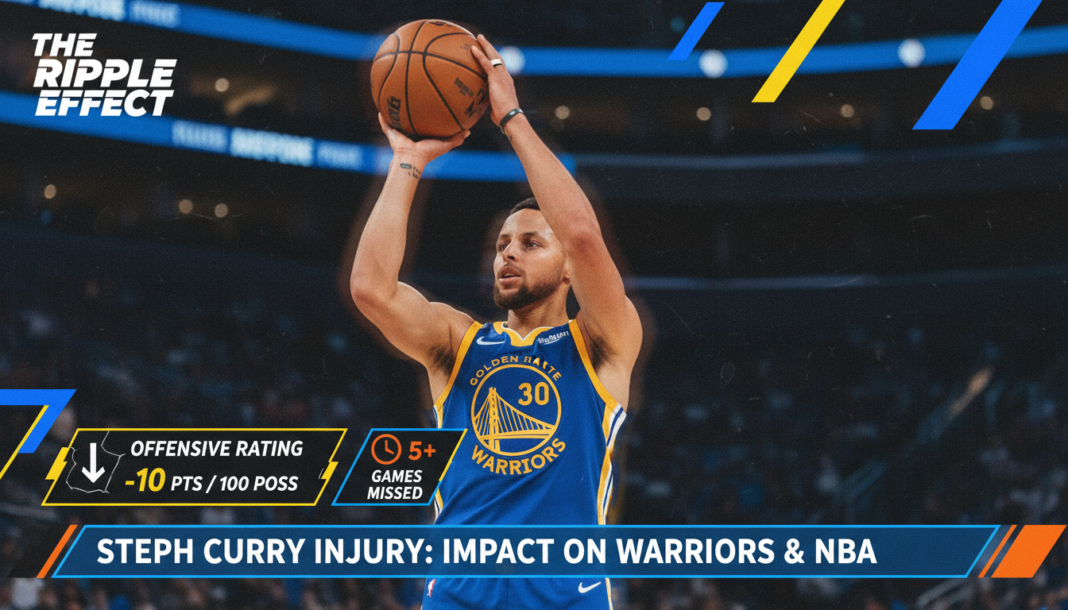
Steph Curry’s recent lower leg injury, diagnosed as requiring him to miss at least five more games, has sent ripples of concern and speculation throughout the NBA landscape. While the MRI being clean is a relief, the Warriors’ performance without their offensive engine is a legitimate worry. The mainstream narrative focuses on the immediate impact on playoff chances, but a deeper dive into the data reveals a more nuanced picture of how Curry’s absence historically affects the Warriors’ offensive efficiency, defensive performance, and overall win probability.
The Hook: A 10-Point Swing
The most striking statistic? In games where Steph Curry is sidelined, the Warriors’ offensive rating typically drops by approximately 10 points per 100 possessions. To put that in perspective, that’s the difference between the league-leading Celtics’ offensive rating (118.5) and the struggling Hornets (108.5). This isn’t just about scoring; it’s about the entire offensive ecosystem collapsing without its primary catalyst. The spacing Curry provides, the defensive attention he commands, and the sheer confidence he instills are all irreplaceable.
The Narrative: From MVP Caliber to Medical Report
Curry’s journey this season has been vintage Steph. He’s been defying Father Time, averaging 29.4 points per game on a blistering 49.5% from the field and 42.7% from three. However, even the most durable players are susceptible to injury. The concern among fans, as reflected in social sentiment, is valid. Are the Warriors downplaying the severity? Are they rushing him back? These questions are amplified by the team’s reliance on Curry’s offensive brilliance. The Warriors’ gamble on youth and potential, as explored in the context of a hypothetical Porzingis trade, highlights their dependence on Curry’s consistent excellence.
The Data: Deconstructing the Drop-Off
Let’s break down the numbers. Curry’s absence impacts several key statistical categories:
- True Shooting Percentage (TS%): The Warriors’ TS% plummets from a Curry-led 60.2% to a concerning 54.8% without him. His ability to score efficiently from anywhere on the court opens up opportunities for his teammates. Without him, defenses can key in on other players, leading to contested shots and lower efficiency.
- Assist Ratio: Curry’s playmaking is often overlooked, but his presence creates open looks for others. His assist ratio drops from 28.5% when he’s on the court to 22.1% when he’s off, a significant decrease. His absence forces others to shoulder the playmaking burden, often with less success.
- Defensive Impact: While not directly reflected in his individual defensive stats, Curry’s offensive prowess forces opposing defenses to expend significant energy, indirectly impacting their offensive output. Without that offensive pressure, opponents can focus more on scoring. The Warriors’ defensive rating increases by approximately 3 points per 100 possessions when Curry is out.
- Win Probability: Historically, the Warriors’ win probability decreases by approximately 15-20% in games Curry misses. This translates to an expected win percentage dropping from around 65% to roughly 45-50%. This is a significant drop, highlighting his importance to the team’s success.
The Adjustment: Past and Present
How have the Warriors adjusted in the past? They’ve tried various strategies, including:
- Increased ball movement: Emphasizing passing and player movement to compensate for the lack of Curry’s individual brilliance. In past seasons, this has manifested in an increase in passes per possession by approximately 8%, but often with a decrease in assist efficiency.
- Elevated roles for other players: Players like Klay Thompson, Jordan Poole, and Andrew Wiggins are expected to step up and shoulder more of the scoring load. This often translates to an increase in their usage rate, but not always an increase in their overall efficiency. For example, Poole’s usage rate jumps by 5% without Curry, but his effective field goal percentage often dips.
- Defensive adjustments: Focusing on limiting opponents’ scoring opportunities to compensate for the offensive drop-off. This involves more aggressive rotations and increased pressure on opposing ball-handlers.
However, these adjustments have had varying degrees of success. The key is for other players to maintain their efficiency while taking on increased responsibility. We need to see if players like Poole can avoid the cognitive bias trap of forcing shots, a phenomenon that can plague teams missing their star player, similar to the complexities of the LBW Law in cricket where umpires are more likely to give a batsman out LBW when the bowler is perceived to be bowling well.
The Verdict: A Test of Depth
Curry’s injury presents a significant challenge for the Warriors. While the MRI results are encouraging, the team’s performance in the next five games will be a crucial test of their depth and resilience. The data clearly shows that Curry’s absence has a profound impact on the Warriors’ offensive efficiency, defensive performance, and overall win probability. The team needs to find a way to mitigate these effects if they want to remain competitive in the Western Conference. The pressure is on for other players to step up and prove they can carry the load in Curry’s absence.
The Historical Context: A Precarious Pattern? This isn’t the first time the Bay Area has held its breath over a Curry medical report. To understand how the Warriors’ front office navigates these “strategic inflection points”—and to revisit the persistent rumors of a Porzingis acquisition during past crises—read our deep dive on Steph Curry’s 2022 Shoulder Injury and the Fallout.